

We often think of habits as small acts. Brushing our teeth. Checking our phone. Taking the same route home. But inside the brain, these repeated actions are not small at all. They shape attention, feeling, memory, and choice.
Habits are learned patterns that help the brain save effort by turning repeated actions into automatic responses.
This helps us in daily life. We do not want to rethink every tiny act from the start. Still, this same system can trap us in patterns that no longer serve us. That is why habits feel easy to repeat and hard to change.
We have all felt this. One day we decide to act differently. A few hours later, we find ourselves doing the old thing again. It can feel almost mechanical. In part, it is.
Why the brain likes routines
The brain is always managing energy, attention, and reward. When we repeat a behavior in the same setting, the brain begins to link cue, action, and outcome. Over time, that chain becomes faster and less conscious.
A review on the psychology of habit described habits as patterns with cognitive, motivational, and neurobiological features. It also showed that habits and goals are not enemies by default. They can work together. A routine can act like a default path, while conscious goals guide direction.
That helps explain why routines can feel calming. They reduce the number of decisions we must make. They also create predictability, and the mind often responds well to predictable structure.
What repeats, rewires.
Still, not every repeated act becomes a strong habit at the same speed. A systematic review on habit formation found large variation in how long habits take to form. Median estimates were around 59 to 66 days, while mean estimates ranged from 106 to 154 days. Some habits formed in a few days. Others took many months. Morning routines and self-chosen behaviors often became stronger faster.
We think this matters because many people quit too soon. They assume failure when the real issue is time, context, or weak repetition.
What happens in the brain during habit formation
As a behavior becomes familiar, brain activity shifts. In early learning, more reflective systems are involved. We pause, compare options, and think about results. With repetition, control moves toward systems linked to automatic action.
Habit formation is not just repetition. It is repetition tied to cues, reward, and context.
A 2026 study on goal-directed response switching and habitual control found that overtrained stimulus-response links increased switch costs. In simple terms, once a behavior was trained deeply, changing away from it became slower and harder. Brain scans showed stronger involvement of sensorimotor regions and the posterior putamen in overtrained behavior. Standard-trained actions used areas linked to more flexible control, including the posterior caudate, insula, and prefrontal regions.
This tells us something practical. A habit is not just in our mind as an idea. It is built into action systems. The body begins to expect the sequence.
Reward, prediction, and automatic action
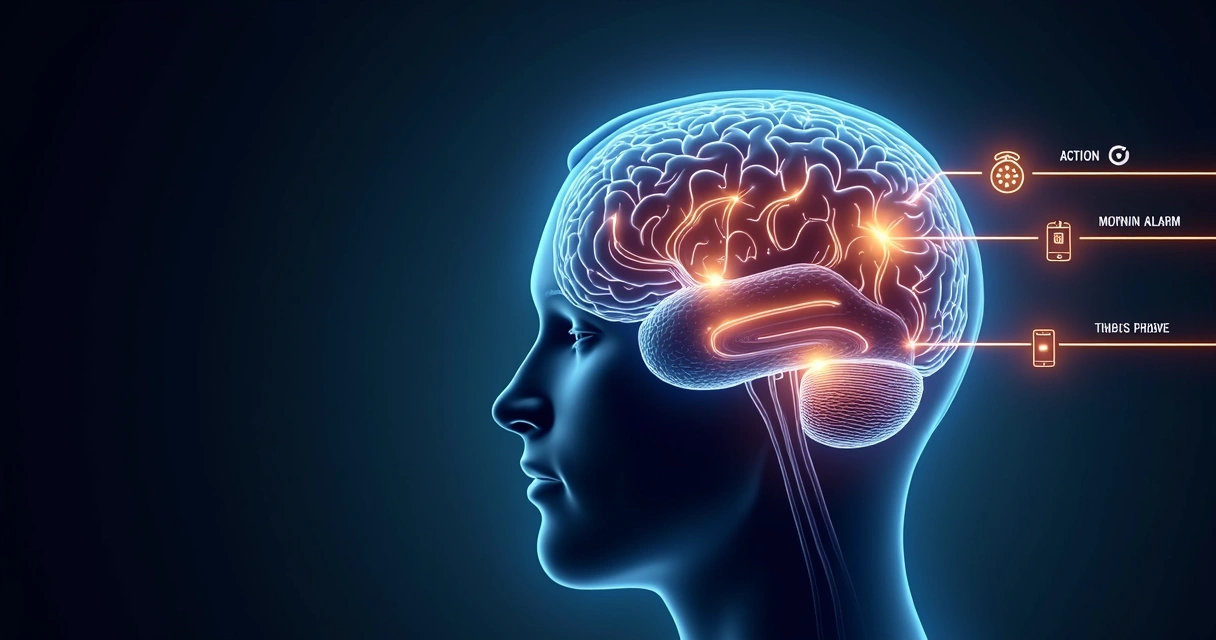
Why does the brain keep repeating certain routines? Because it learns from outcomes. If an action brings relief, pleasure, social comfort, or even a brief drop in tension, the brain tags that pattern as worth repeating.
Research from reinforcement-learning work on habit formation showed that animals developed action patterns that reduced delay to reward. This supports the idea that habits grow through learning systems that weigh cost and reward over time.
We can see this in ordinary life:
We feel stress, then reach for sugar.
We hear a notification, then check the screen.
We finish dinner, then want something sweet.
At first, these are choices. Later, they can become loops. The cue arrives, and the action follows before reflection has much time to speak.
One quiet problem is that the reward does not need to be large. It only needs to be consistent enough for the brain to learn the pattern.
Can conscious control still intervene?
Yes. The brain is not locked into habit. It can interrupt, revise, and retrain. But that process asks for awareness and repeated correction.
A neuroscience report on cortical control of habits identified a small prefrontal area involved in moment-to-moment control over habitual behaviors. The finding suggests that executive systems can switch control between old and new patterns when goals or context change.
The prefrontal cortex helps us pause, notice a pattern, and choose a different action.
We find this encouraging because it matches lived experience. A person may still feel the pull of an old routine, yet with practice they can build a pause between cue and response. That pause is often where change begins.
One simple story comes to mind. Someone decides to stop checking messages the moment they wake up. The first mornings feel odd. Their hand moves before the mind agrees. But they place a book on the bedside table instead. After enough repetition, the first action of the day changes. Not by force alone, but by redesigning the cue and response.
How routines influence mood and mental clarity
Routines shape more than behavior. They affect emotional tone. A steady sleep schedule, regular meals, movement, and quiet periods can reduce mental noise. On the other hand, chaotic routines can leave the mind strained, reactive, and scattered.
This does not mean every hour must be planned. In our view, healthy routines give structure without rigidity. They support steadiness, not control for its own sake.
Helpful routines often include:
Regular sleep and waking times
Simple morning actions that reduce rush
Clear boundaries for digital use
Repeated forms of movement or rest
These habits can lower decision overload and free mental space. They may also support emotional regulation because the brain does not need to react to constant unpredictability.

Changing a habit without fighting yourself
Many people try to remove a habit by using willpower alone. Sometimes that works for a short time. Often it does not. A better path is to study the loop.
We can ask:
What cue starts the behavior?
What feeling or reward follows it?
What new response can fit the same moment?
If we keep the cue and change the action, the brain has a better chance to learn a new pattern. This is often easier than trying to erase the old one in empty space.
It also helps to make the new habit visible and simple. The less friction around the new response, the better. A walking habit starts more easily when shoes are by the door. A reading habit starts more easily when the book is already open on the table.
Conclusion
Habits are one of the brain’s main ways of shaping daily life. They reduce effort, guide attention, and influence how we feel, act, and interpret our world. Some routines protect mental balance. Others narrow it.
When we understand the neuroscience of habit, we stop treating repeated behavior as a moral flaw or a fixed trait. We begin to see patterns, cues, rewards, and brain systems working together. That view gives us more patience and more responsibility.
Small acts count. Repeated small acts count even more.
Frequently asked questions
What is a habit in neuroscience?
In neuroscience, a habit is a learned behavior that becomes automatic through repetition. It is usually triggered by a cue and carried out with less conscious thought over time. The brain stores these repeated patterns so actions can happen faster and with less effort.
How do habits change the brain?
Habits change the brain by strengthening neural pathways linked to repeated actions. As a behavior is practiced, control can shift from reflective brain areas toward regions involved in automatic action, such as parts of the basal ganglia and sensorimotor systems. This makes the behavior easier to repeat and harder to switch.
How to break a bad habit?
To break a bad habit, we need to identify the cue, understand the reward, and replace the old response with a new one that fits the same moment. It also helps to reduce exposure to triggers and make the new action easier to perform. Change tends to work better through repeated redesign than through force alone.
Why are routines important for the mind?
Routines are good for the mind because they reduce decision overload, create predictability, and support emotional steadiness. Regular patterns around sleep, meals, movement, and rest can help the brain feel less scattered and more settled during the day.
Can habits improve mental health?
Yes, habits can improve mental health when they support sleep, self-care, movement, reflection, and healthy boundaries. Positive routines can lower stress, support mood regulation, and create a greater sense of stability. Their effect grows when they are repeated in a realistic and meaningful way.