

We all carry quiet ideas about who we are, what others are like, and what life will allow us to become. These ideas often sit below daily awareness, yet they shape our choices with great force. When we say, “I always fail,” or “People leave when I need them,” we are often hearing a core belief speak.
Core beliefs mapping is the practice of tracing repeated thoughts, emotions, and reactions back to the deeper belief that feeds them.
This work matters because self-growth is not only about changing habits on the surface. In our experience, real change gets stronger when we understand the inner sentence behind the habit. A person may delay hard tasks, avoid closeness, or seek constant approval, but the deeper pattern may be a belief such as “I am not good enough” or “I am only safe when I please others.”
We have seen that people often feel relief the moment they name the belief. Not because the work is done, but because confusion starts to clear. The inner world becomes more legible. That is where conscious self-growth begins.
What core beliefs actually are
Core beliefs are broad conclusions we form about ourselves, other people, and the world. Many begin early, through repeated experiences, strong emotional events, family messages, school pressure, or social comparison. Once formed, they tend to filter perception. We notice what confirms them and dismiss what challenges them.
Some common examples include:
I am unworthy.
I must be perfect to be accepted.
People cannot be trusted.
If I fail once, I am a failure.
My needs are a burden.
Core beliefs are not facts. They are learned interpretations.
That distinction changes everything. A belief may feel old, heavy, and true, yet still be incomplete or false. We think this is one of the most freeing insights in inner work.
Why mapping works better than vague reflection
Many people reflect without structure. They journal, think, and revisit the same pain, but the pattern stays blurry. Mapping gives shape to the process. It lets us move from event, to thought, to feeling, to belief.
Clarity reduces inner noise.
There is another reason this matters. Beliefs about growth and ability affect action. Research from OECD PISA 2022 found that growth mindset is linked with stronger self-efficacy, curiosity, and persistence, with strong effects among middle-range students. We can take a useful lesson from this. When people believe change is possible, they tend to stay engaged with effort. Core beliefs mapping helps us catch the fixed inner statements that block this openness.
How to build a core beliefs map
You do not need a perfect system. A notebook page is enough. What matters is honesty and sequence. We suggest moving in five steps.
Start with a repeated trigger
Choose one situation that keeps showing up. Maybe we shut down after criticism. Maybe we panic when someone takes too long to reply. Maybe we overwork, then feel empty.
Write one recent event in plain words. Stay concrete. “My manager corrected my draft.” “My friend canceled dinner.” “I made a small mistake in public.”
Name the automatic thought
Next, write the first thought that appeared. Not the polished version. The raw one.
They think I am incompetent.
I am not a priority.
I looked foolish.
This part can feel uncomfortable. We may notice how harsh the inner voice is. That is normal.
Identify the emotion and body response
Then write what you felt and where you felt it. Shame in the chest. Anxiety in the stomach. Anger in the jaw. Sadness behind the eyes. The body often reveals what the mind tries to skip.
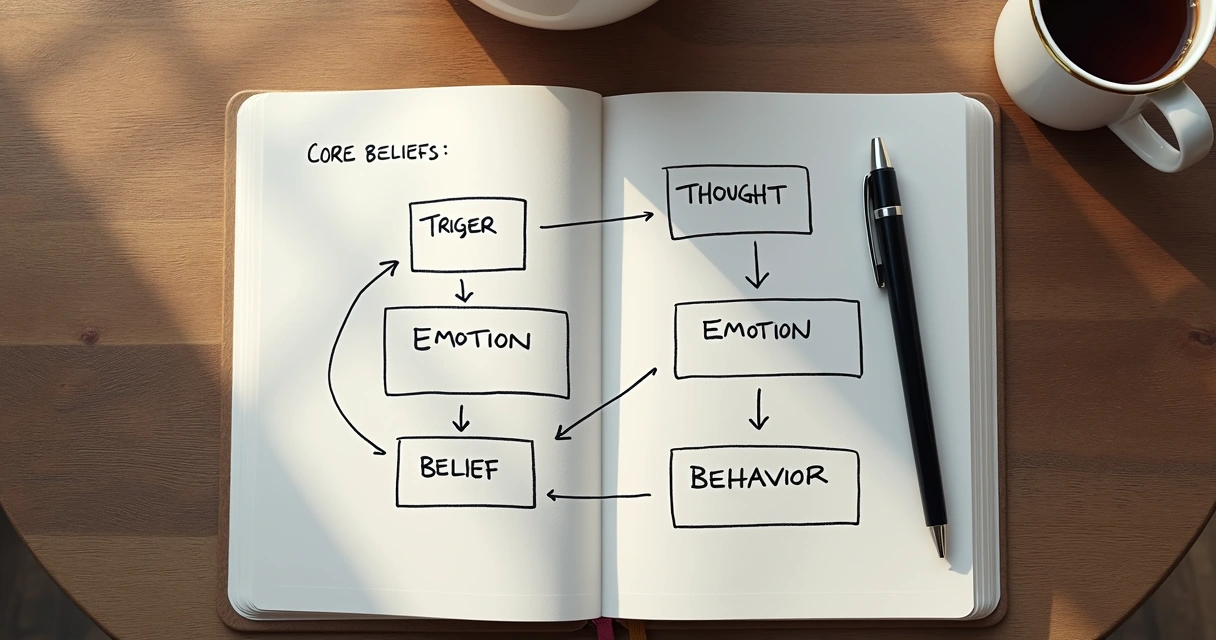
Track the behavior that followed
Now ask what you did next. Did you withdraw, attack, explain too much, people-please, or numb out? Behavior often protects the belief while also keeping it alive.
A good belief map shows how one hidden idea can guide thought, feeling, and action in a single chain.
Ask the deeper question
Finally, ask: “If this thought were true, what would it say about me?” Keep going until the sentence becomes broader and more personal.
For example:
My manager corrected my draft.
Automatic thought: I did it wrong.
Deeper meaning: I am not capable.
Core belief: I am inadequate.
That last sentence is the one to mark. It is often short, global, and painful.
How to test a core belief with care
Once a belief is visible, we should not rush to replace it with a cheerful statement we do not believe. Forced positivity rarely holds. We need a more honest method.
We suggest three checks:
Ask where the belief came from. Which repeated experiences taught it?
Ask what evidence seems to support it, and what evidence does not.
Write a fairer belief that feels believable, not fake.
So instead of “I am inadequate,” a fairer belief might be, “I am still learning, and one mistake does not define my ability.” This has room for truth, effort, and dignity.
We also find it helpful to look at self-concept with nuance. A Dutch longitudinal study following students from Grade 6 to Grade 9 showed that math self-concept shaped later outcomes, while also showing that confidence can work differently depending on context. This reminds us that beliefs about ourselves matter, but they must stay grounded in reality. Healthy self-growth is neither self-attack nor self-inflation.
What to do after the map is done
A map is not a trophy. It is a working document. Once we find a core belief, we can begin to loosen its hold through repeated conscious practice.
Here are useful next steps:
Write a balanced replacement belief and read it daily.
Notice each moment the old belief gets activated during the week.
Act once in a way that the old belief would normally block.
Journal about the result without judging yourself too fast.
Sometimes the shift is quiet. We speak up once. We rest without guilt once. We allow a mistake without collapse. Small acts matter because they teach the nervous system a new pattern.

Common mistakes to avoid
Even a good practice can become distorted. We have seen a few patterns that make belief mapping less helpful.
Mapping too many issues at once and getting lost.
Treating one painful thought as a final truth.
Using the map to judge yourself instead of understand yourself.
Expecting one session to undo years of conditioning.
The goal is not to find what is wrong with us. The goal is to see clearly how we learned to protect ourselves.
That shift brings compassion into the process. And compassion helps insight last longer.
Conclusion
Core beliefs mapping gives structure to inner awareness. It helps us move from reaction to understanding, from confusion to language, and from hidden assumptions to conscious choice. When we trace a repeated struggle back to the belief beneath it, we gain a chance to respond with more maturity and less automatic fear.
We do not change deeply by arguing with ourselves all day. We change when we can see our patterns, name them honestly, and practice a fairer way of meeting life. That is the quiet strength of this method. It turns self-growth into a clear practice, one belief at a time.
Frequently asked questions
What is core beliefs mapping?
Core beliefs mapping is a structured way to trace recurring thoughts, emotions, and behaviors back to the deeper belief that drives them. It helps us identify hidden ideas such as “I am not enough” or “People cannot be trusted,” so we can question them with more awareness.
How can I start core beliefs mapping?
We can start with one recent situation that caused a strong emotional reaction. Then we write the trigger, the first automatic thought, the emotion, the behavior that followed, and the deeper meaning behind it. After that, we look for the short belief statement that connects the whole pattern.
Is core beliefs mapping worth trying?
Yes, especially if we feel stuck in repeated emotional patterns. This method can make self-reflection clearer and more useful because it shows what sits beneath surface habits. Many people find that naming the belief already brings a sense of relief and direction.
What are the benefits of core beliefs mapping?
The benefits include stronger self-awareness, better emotional clarity, and more thoughtful responses to stress. It can also help us challenge harsh self-judgments, build fairer self-beliefs, and create change that feels more stable over time.
How often should I do core beliefs mapping?
A weekly practice works well for many people, especially when we focus on one pattern at a time. We can also do it after a strong trigger or conflict. What matters most is not frequency alone, but steady and honest reflection.